
Decoding Money Serenity™
The Hidden Psychology Behind Why You Feel Broke, Lonely, & Scared And the System That Fixes It
Here’s a Preview of the Book ↓
INTRODUCTION
If you’ve ever been scared –from a movie or thrill ride or a car accident, house fire, or anything else, you know it’s not a way you want to live every day.
Always on edge.
When you’re struggling with your finances, when you have money problems, you’ll feel like you’re on the edge of disaster constantly.
That level of living slows your mental processes. That’s the kind of stress that keeps you up at night. The kind that doesn’t let your mind rest.
There’s no serenity.
You’re dealing with constant stress. Even if you can’t figure out why there’s stress in your life, even if you don’t know exactly what’s got you up at night worried, it’s stress.
The human brain interprets all stress -regardless of the origin or reason- as a threat.
So, your reactions to it are instinctual. It’s about survival. It doesn’t matter whether you’re facing a genuine life-threatening circumstance or can’t cover your bills this month: your brain doesn’t differentiate.
People who don’t struggle financially can’t understand those of us who do, especially when you earn a decent salary. They can’t understand the constant, everyday strain we experience. They might not understand why we ignore the bills, spend money on things when we’re already running out of funds, or can’t manage our funds.
Want to know a secret, though? Those people aren’t perfect. They may not worry about money, but they’re dealing with other types of stress, even if they haven’t yet figured out what that is.
Yes, there are an abundance of financial gurus out there who write books, build courses, have podcasts and call-in shows, websites, and every trick in the book who pound us with guilt for our mistakes, who ask, “Why did you do that?” when we confess our sins.
Do we need to listen to them? Not always. Sure, their advice is often sound and they certainly know what they’re talking about as far as budgeting and investing and so forth is concerned, but like the diet fads and exercise masters of the world… if they were actually helping people -not just short-term, but long-term help- then obesity and a lack of physical fitness wouldn’t be a growing problem in some parts of the world.
Just as financial stress wouldn’t be a continually growing and increasing problem globally.
But it is.
Why?
Because all the traditional tools, models, guides, and
Want to read further?

You Make Good Money. You Pay Your Bills. So Why Does Money Still Keep You Up At Night?
Because your brain treats every financial worry like a threat to your survival. No budget was ever designed to fix that. This book reveals why you feel this way and offers a proven system to calm your financial anxiety.

It's late.
You're tired. Really tired.
But your brain won't stop.
You're running through the numbers again. The same ones you ran through yesterday. And the day before that. The bills are mostly paid. Nothing is on fire. And yet here you are, lying in the dark, feeling like something is very, very wrong.
Nothing is wrong with you.
But something is happening. And nobody has ever taken the time to explain it to you.
Until now.

Want to know a secret?
That low hum of financial dread you carry around everywhere you go — the one that never fully goes away no matter how much you earn, no matter how many bills you pay, no matter how hard you try — it's not because you're irresponsible.
It's not because you're bad with money.
It's not even because of your income.
It's because nobody has ever helped you understand why you do what you do.
And you can't fix what you don't understand.
Does any of this sound like your life?

You check your bank account more times than you'd like to admit. Or you've stopped checking altogether because honestly, either way, it stresses you out.

A bill arrives. Something tightens in your chest. You set it aside. You tell yourself you'll deal with it later. You know how that story ends.

You earn a decent income. You're not broke. And yet there's this quiet, persistent feeling that you're one unexpected expense away from everything unraveling.

You've tried the budgets. The apps. The spreadsheets. You've read the books. You know what you're supposed to do. So why can't you make yourself do it?

You look at the people around you — the ones who seem calm, settled, like they've figured something out — and you wonder: what do they know that I don't? What is actually wrong with me?
Here's what I want you to hear.
Nothing is wrong with you. Not a single thing.
Every finance book, every guru, every podcast episode that's ever told you to track every dollar, cut the lattes, and just try harder... They all started at the wrong place.
They told you what to do. But not one of them told you why you couldn't do it. And that's the part — the only part — that actually matters.
Here's the truth your brain has been trying to tell you all along: When a bill lands in your inbox, when your balance dips lower than you'd like, when a conversation about money makes your stomach drop — your brain doesn't treat that as a minor inconvenience.
It treats it as a threat.
The same hard-wired survival response your brain would use if your life were actually in danger.
And when your brain is in threat mode? It does one of two things.
It fights.
Or it runs.
For most of us dealing with money stress - and I mean most of us, not just a struggling few - running looks like this: The bill gets set aside. The bank app goes unopened. You spend a little money you shouldn't just because it feels like relief for five minutes. You tell yourself you'll sort it out next month.
That's not weakness. That's not laziness. That's not you being bad with money.
That's your brain doing exactly what it was designed to do under pressure.
This is called the shame-avoidance spiral.
And it's the reason — the real reason — that every budget, every spreadsheet, every "just be more disciplined" lecture has never created lasting change for you.
You can't willpower your way out of a psychological pattern.
You have to understand it first.
That's what this book does.
The primary pain point isn't debt or lack of savings. It's the daily burden of financial decision-making and the gap between what people earn and how safe they feel. This is a psychological problem — and it has a psychological solution.
INTRODUCING
Decoding Money Serenity™
The Hidden Psychology Behind Why You Feel Broke, Lonely & Scared — And the System That Fixes It
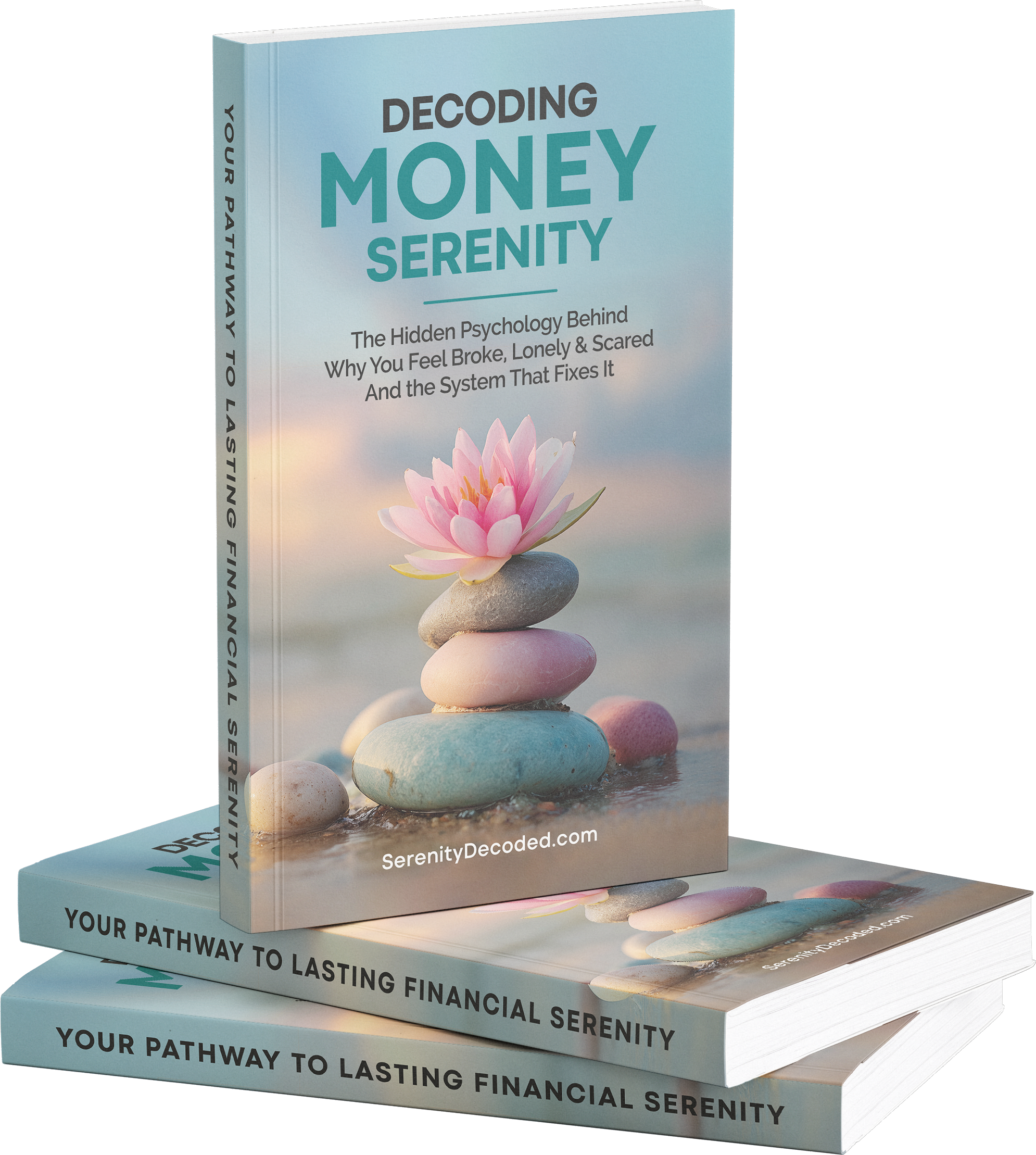
This is not a budgeting book.
It's not going to tell you to track every dollar. It's not going to ask you to cut things you love. It's not going to smack you over the head for choices you've made in the past.
We've had enough of that, haven't we?
This book starts where every other finance book refuses to go — inside your head.
It explains, in plain everyday language, exactly what's been happening psychologically every time money stress shows up. Why the avoidance kicks in. Why guilt makes everything worse. Why you keep repeating the same patterns even when you know better.
And then — only then, once that foundation is actually in place — it walks you through a simple, practical system built around how you actually behave. Not the perfect, disciplined version of yourself you've been trying to become for years.
Think of it this way.
All those other books told you what to do.
This one finally explains why you couldn't.
Here's what's waiting for you inside. All of it.
PART 1
You Are Not Bad with Money

Before anything changes, the guilt has to go. Not because guilt isn't real, but because it's the thing — the main thing — that's been keeping you stuck. This part tears that down. Completely. Using real science, not opinions, not lectures, not shame. Just the truth about why your brain responds to money stress the way it does.
You'll walk away from this section feeling something you probably haven't felt in a while.
Permission. Permission to stop being so hard on yourself.
Then we can actually move forward.
PART 2
Money and Your Brain

This is where everything clicks into place.
You'll see, clearly, finally — why your brain behaves the way it does around money. Why 'trying harder' was never going to be enough.
Why emotional spending isn't stupidity, it's survival. And what's actually driving the patterns you've been trying to break for years.
This isn't soft. This isn't 'just think positive.' This is the mechanism that makes everything else in this book actually work.
PART 3
Stability Before Wealth

Here's the problem with most financial advice.. it starts too far ahead. It assumes you already have breathing room.
That you've already got a little cushion. That you're already in a stable enough place to start optimizing.
Most of us aren't there yet. And that's okay.
This part meets you exactly where you are. Not where a guru thinks you should be. Right here, right now, in your actual life. And it builds breathing room first — because without breathing room, everything else is just more pressure on an already-full plate.
PART 4
Practical Money for Real Life

This is where the practical tools come in.
But not the kind that require you to be a different person to use them. Not rigid rules. Not guilt-inducing spreadsheets you'll abandon by week three.
Just simple, honest frameworks built around how you actually make decisions — on your worst days, not just your best ones.
Because a system that only works when everything is going great isn't really a system at all.
PART 5
A Calmer Financial Future

This is what the whole book has been building toward.
Not overnight wealth. Not becoming a different person. Not impressing anyone.
Just quiet. Steady. Daily peace with money.
Waking up and not immediately running the numbers in your head. Opening your bank app without that familiar drop in your stomach.
A bill arriving and you dealing with it that day, without the dread.
That's what serenity looks like. And it's closer than you think.
This is what shifts when you finally understand what's been happening.
WHERE YOU ARE NOW
That low-level dread that never fully goes away
Avoiding the bank app, the bills, the hard conversations
Running mental math in the background all day long
Guilt after every financial decision, big or small
Trying hard — but nothing ever really sticks
Feeling behind no matter what you earn
Bracing for the next thing to go wrong
WHERE YOU WILL BE AFTER
Quiet, steady calm. The kind you can actually feel.
Opening your accounts without flinching
A simple system that runs without constant willpower
Decisions made without second-guessing yourself to death
Progress that actually holds this time
Knowing exactly where you stand — and feeling okay about it
Waking up without waiting for the other shoe to drop
You're probably thinking something right now. Let's talk about it.
''
"I've read finance books before and nothing changed. Why would this be different?"
Because those books started with the wrong thing. They handed you tactics before they helped you understand why you couldn't follow through in the first place. The shame. The avoidance. The patterns that feel automatic and completely out of your control. That's what this book addresses first. The practical stuff comes later — and this time, it actually lands, because the foundation is finally in place.
''
"My problem is my income. Psychology isn't going to fix that."
Here's what the research actually found. Financial anxiety hits hardest among people who earn enough. Middle-income earners. People who, by every external measure, 'shouldn't' be this stressed. Income and peace don't automatically go together. If they did, you wouldn't be reading this right now.
''
"I just need discipline. I don't need a feelings book."
Discipline is a finite resource. Any system that requires you to fight your own brain every single day will eventually lose — because you're human, not a machine. This book doesn't ask you to be more disciplined. It builds systems designed to work even on the days your discipline runs dry. That's not soft. That's just smarter.
One book. One real shift. Starting today.
Decoding Money Serenity™
$17.99 Free shipping · Paperback in your hands within days
$17.99 Free shipping · Paperback in your hands within days
Here's our promise to you.
Read it. Sit with it. Do the action steps. And if it doesn't shift the way you think and feel about money — genuinely, noticeably shift it — reach out and we'll make it right. No lectures. No hoops. No fine print.
You've carried this long enough. The only thing you lose by not trying is more time feeling exactly the way you feel right now.
Real financial peace isn't loud.
It doesn't announce itself. It doesn't look like a windfall or a sudden promotion or finally hitting some magic number in your savings account.
It's quieter than that.
It's opening your bank app and feeling... nothing bad.
It's a bill arriving and you dealing with it the same day without the dread.
It's going to bed and actually resting. It's money finally feeling like something that works for your life — not something that has a quiet, relentless grip on it.
That's what serenity looks like.
And it starts here.
The Weight You Have Been Carrying Around Money Did Not Build Overnight.
But understanding it can start today.
Paperback · Ships within days
Serenity Decoded All Rights Reserved © 2026